
Shopify is a leading all-in-one commerce platform used by millions of businesses to grow and manage their online stores. It offers four main plans, Basic, Grow, Advanced, and Plus, each tailored to different business sizes and needs. The Basic plan is ideal for small teams, while Grow suits slightly larger operations with minimal staff (Shopify About, 2025).
One of Shopify’s standout features is its advanced checkout system, allowing customers to complete purchases with a single click. Regardless of the plan, users can sell an unlimited number of products and services. Payment processing rates vary: the Basic plan charges 2.9% + $0.30 per transaction, while the Advanced plan lowers that to 2.5% + $0.30. Premium cards, including corporate and American Express, may incur higher fees (Shopify About, 2025).
All plans include access to Shopify’s top-tier checkout experience, in-person selling tools that sync inventory between online and physical stores, and multi-channel sales options through platforms like TikTok, Google, and Instagram. Merchants also benefit from in-depth analytics and a wide selection of commerce apps to enhance their store’s performance and customer experience (Shopify About, 2025).
The Basic plan includes a wide range of professionally designed templates, built-in website tools, a free custom domain, AI-powered services, and support for up to two contributors. The Advanced plan expands on these features by allowing unlimited contributors, offering advanced website analytics, professional email integration, and enhanced site management tools (Squarespace Pricing, 2025).

Squarespace stands out for its intuitive design interface and extensive template library, giving users more creative control over the look and feel of their site. However, when it comes to more e-commerce functionality, Shopify has the edge (Squarespace Pricing, 2025). Shopify excels in point-of-sale (POS) capabilities, customer support, and SEO optimization tools, making it a stronger choice for businesses focused on the operational efficiency (Hennigan, 2024). Squarespace is ideal for users seeking a visually appealing, easy-to-use platform with essential e-commerce features, while Shopify is better suited for merchants who need advanced tools and deeper customization for business growth (Hennigan, 2024).
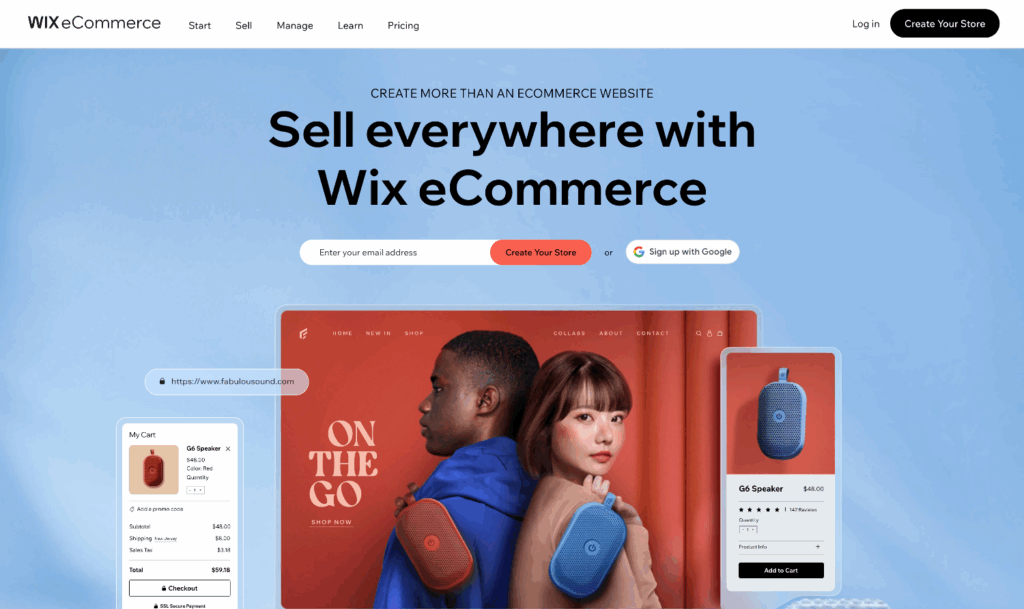
WiX offers a highly customizable storefront design tailored to a wide range of business types, with built-in AI tools that help turn creative vision into reality. It supports both in-person and online selling, with easy syncing of inventory and orders across platforms. WiX provides four pricing plans: Light, Core, Business, and Business Elite (WiX Plans, 2025). The Light plan includes 2 GB of storage, multi-cloud hosting, a light marketing suite, and support for two site collaborators. For businesses seeking a more e-commerce experience, the Business plan adds expanded storage, a standard marketing suite, integrated point-of-sale (POS) capabilities, and tools for scheduling and service management (WiX Plans, 2025).
One of WiX’s standout features is its design flexibility. Compared to Squarespace, WiX allows more freedom in customization, which is ideal for users who want full creative control. However, this flexibility can come at the cost—WiX may feel more complex for users who aren’t as tech-savvy (Wix vs Squarespace, n.d.). While WiX offers a broader range of templates, Squarespace is known for its cleaner, more visually engaging designs. Squarespace templates tend to be more polished and user-friendly, making it a favorite among creatives and small businesses focused on aesthetics (Wix vs Squarespace, n.d.).
One of WiX’s standout features is its design flexibility. Compared to Squarespace, WiX allows more freedom in customization, which is ideal for users who want full creative control. However, this flexibility can come at the cost of ease-of-use—WiX may feel more complex for users who aren’t as tech-savvy (Wix vs Squarespace, n.d.). While WiX offers a broader range of templates, Squarespace is known for its cleaner, more visually engaging designs. Squarespace templates tend to be more polished and user-friendly, making it a favorite among creatives and small businesses focused on aesthetics (Wix vs Squarespace, n.d.).
WiX provides more direct, built-in service options, whereas Squarespace often relies on third-party integrations for similar functionality. WiX also supports autoplay video features, which Squarespace does not (Wix vs Squarespace, n.d.). For businesses prioritizing design flexibility and built-in support tools, WiX is a strong choice. But for those seeking simplicity and elegant design, Squarespace may be the better fit.