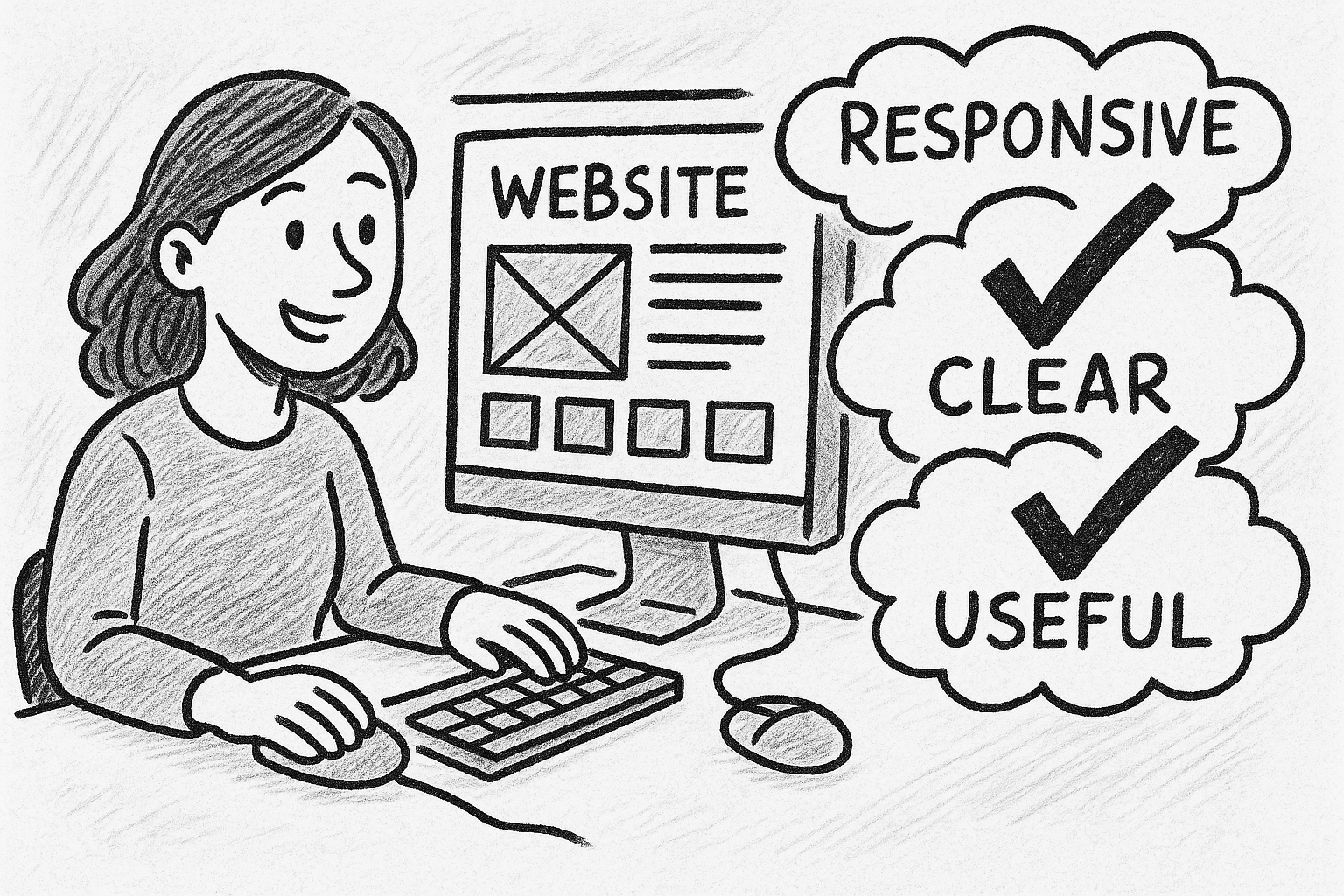
(Image Source: OpenAI, 2025).
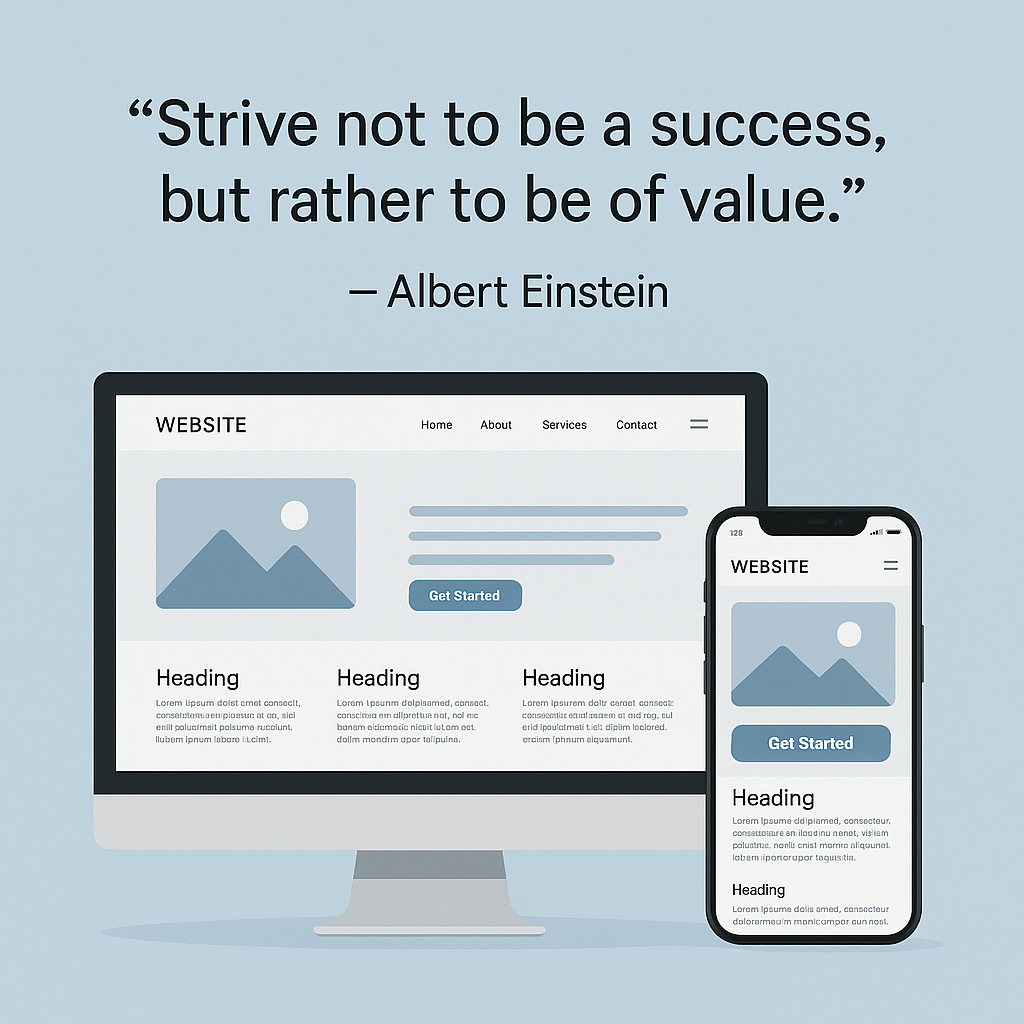
“Strive not to be a success, but rather to be of value” – Albert Einstein.
An Introduction to Core Elements in Website Design
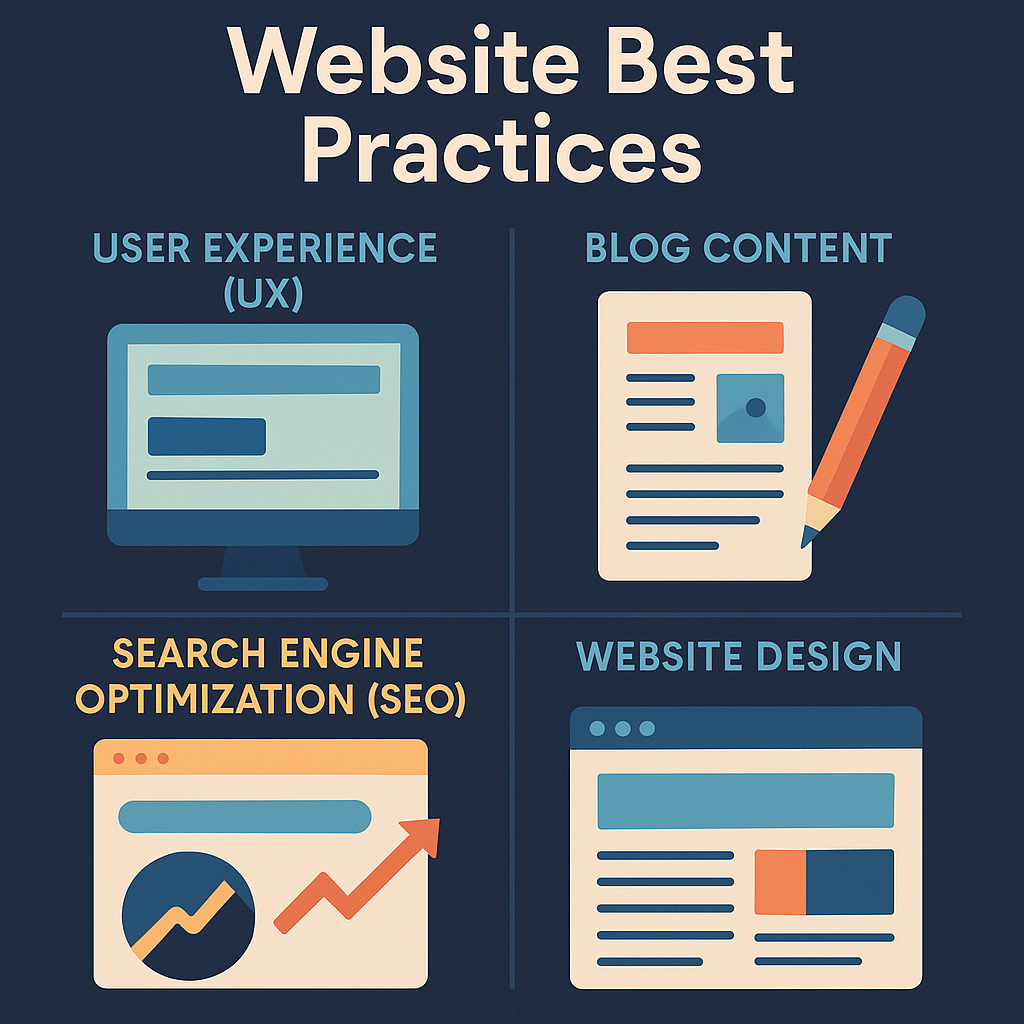
A website provides significant value to an organization and to the community when built with intention and strategy. This article outlines best practices across four key components of a modern web strategy: User Experience (UX), Blog Content, Search Engine Optimization (SEO), and Website Design. Each area contributes to a digital presence that offers value to users and the businesses behind them. Before delving into the core components of an effective web strategy, it is crucial to emphasize that understanding the audience through comprehensive market research is the foundational step. This research informs all subsequent decisions, ensuring that the website’s design, content, and functionality align with the preferences and needs of the target demographic.
USER EXPERIENCE (UX)
What is UX in Website Design?
UX is the foundation of how visitors interact with a site. A positive user experience reduces friction and builds trust. Poor usability, such as inconsistent navigation or cluttered pages, can cause users to abandon a site quickly. Best practices include consistent layout across pages, responsive design for mobile users, and strategic use of whitespace and visual hierarchy to guide attention. Improving UX directly contributes to business performance by reducing bounce rates and encouraging deeper engagement. For example, a well-organized layout with clear calls to action can increase conversion rates, turning casual visitors into loyal customers.
How AI Is Transforming User Experience Design
Artificial intelligence (AI) is transforming the field of UX design. AI systems can analyze user behavior in real-time by examining factors such as scroll depth, navigation patterns, and click activity. This analysis allows for the personalization of content, product recommendations, and even adjustments to page layouts based on individual preferences (Forbes, 2024). While AI applications have been linked to increased user engagement and satisfaction, it is essential to remain vigilant about the privacy and ethical implications involved.
BLOG CONTENT
How Blogging Boosts Long-Term SEO and Organic Visibility
Blogging remains one of the most accessible and effective ways for businesses to connect with their audience and build long-term SEO value. As noted by Business.com, blog posts help businesses improve credibility, rank for niche keywords, and answer frequently asked questions, all of which help attract and retain customers (Malik, 2023). Blogging best practices include:
Writing keyword-informed titles and subheadings
Using formatting techniques like bullet points and short paragraphs
Linking to internal pages and relevant external sources
Adding meta descriptions and image alt text for better search engine interpretation
Ending with clear calls-to-action to guide user behavior
One of the most significant advantages of blogging is its contribution to organic search visibility. Unlike short-term paid campaigns, organic search traffic builds over time, compounding the value of older posts that continue attracting visitors months or even years after publication. This long-term content strategy enhances brand awareness, nurtures potential leads, and improves domain authority, contributing to sustainable digital growth. Consistent, well-structured blog content supports site organization, increases content discoverability, and provides a foundation for implementing broader search engine optimization (SEO) strategies.
Using AI for Blogging: Best Practices to Avoid SEO Penalties
While AI tools can enhance blogging efficiency and support SEO strategies, it’s important to remain mindful of how content is created and deployed at scale. In March 2024, Google updated its search policy to address “scaled content abuse,” a practice where large volumes of low-value content are generated, whether by humans or automation, for the sole purpose of manipulating search rankings. According to Google, this includes pages that appear to answer popular queries but ultimately fail to provide useful or original information (Google, 2024). The focus of this policy is not on how content is made, but rather on whether it serves a meaningful purpose for users. As such, even AI-assisted content should be thoughtfully crafted, fact-checked, and aligned with a clear intent to inform or engage the audience.
SEARCH ENGINE OPTIMIZATION (SEO)
How SEO Connects Your Website with the Right Audience
Imagine crafting a brilliant website, beautifully designed, packed with valuable content, only to have it buried on page 12 of a Google search result. Without proper SEO, even the most impressive websites become digital ghost towns.
Search Engine Optimization (SEO) is essential for improving a website’s visibility in search results without paid ads. It focuses on three key areas: high-quality content, technical performance, and link building. Understanding the target audience, their needs, and their search behaviors is crucial for attracting exemplary visitors.
Effective SEO includes on-page strategies like using keywords in headings, creating clear meta descriptions, and ensuring mobile-friendly design, as well as off-page efforts such as acquiring backlinks from reputable sites. Technical SEO is also important; fast loading times and clean URLs can impact search rankings. Specific keywords, like “family-friendly rafting in Oregon,” often attract more engaged users. Tools like SEMrush and Ahrefs help identify impactful keywords for optimization.
In short, strong SEO begins with research and ends with relevance, connecting one’s business to the right audience at the right time.
WEBSITE DESIGN
The Business Impact of User-Centered Web Design
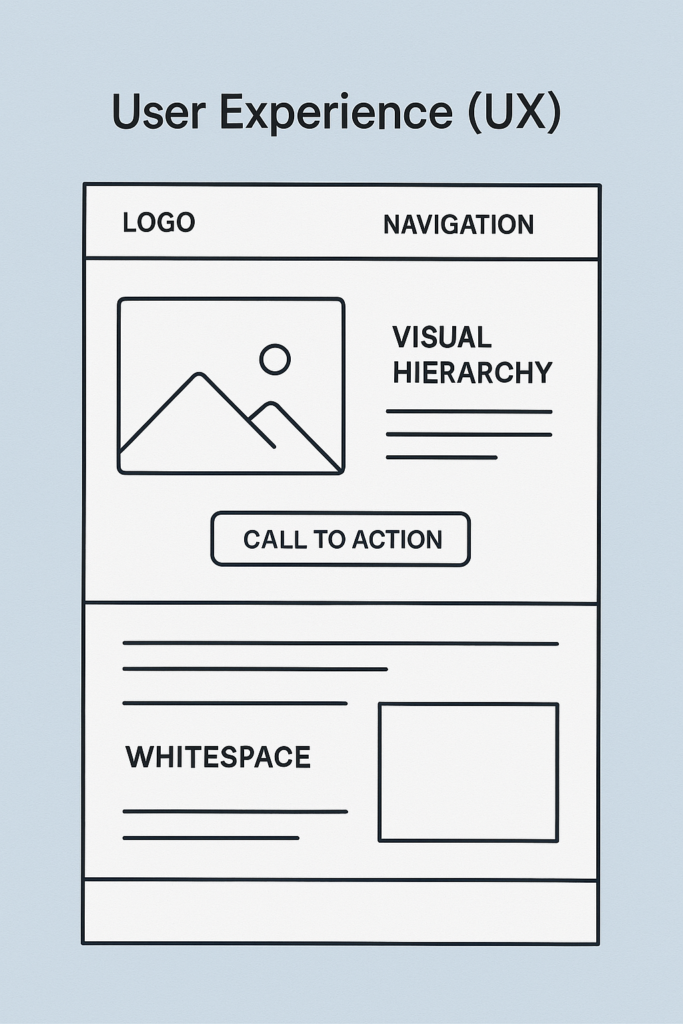
(Image Source: OpenAI, 2025).
First impressions are formed in milliseconds, and design is often the deciding factor. Forbes reports that 88% of users are less likely to return to a site after a poor experience, and 94% of first impressions are design-related (Pradhan, 2024). That is a clear call for thoughtful, strategic visual design. Modern design supports usability, enhances credibility, and aligns with brand identity. Key principles of web design include:
Consistent typography and color palettes
Clear visual hierarchy using spacing and contrast
Mobile-responsive layouts that adapt to different screen sizes
Thoughtful design utilizes principles like white space, typography, and color theory to create intuitive interfaces. A critical yet often overlooked aspect is font selection. Web-safe fonts like Arial, Helvetica, and Times New Roman are consistently supported across different systems, enhancing accessibility and usability (Stokes & the Minds of Quirk, 2013).
Websites prioritizing user experience over aesthetics yield better engagement and stronger brand perception, ultimately improving business outcomes.
SUMMARY OF WEBSITE BEST PRACTICES
The future of digital success belongs to those who build with intention and imagination.
A well-designed website with relevant content and good SEO practices boosts visibility and engagement. Such strategies promote trust and establish digital credibility. The purpose of a website is not merely to inform, but to connect meaningfully with audiences and deliver enduring value.
References:
Forbes. (2024, April 22). Optimizing customer satisfaction: The role of AI in UX design. Forbes Business Development Council. https://www.forbes.com/sites/forbesbusinessdevelopmentcouncil/2024/04/22/optimizing-customer-satisfaction-the-role-of-ai-in-ux-design/.
Google. (2024, March 5). Protecting people from low-quality content on Search. Google Blog. https://blog.google/products/search/google-search-update-march-2024/
Malik, S. (2023, October 13). Small business blogging: 5 reasons it works (and tips for execution). Business.com. https://www.business.com/articles/small-business-blogging-5-reasons-it-works-and-tips-for-execution/.
OpenAI. (2025). ChatGPT (Apr 6 version). [AI-generated images]. ChatGPT. https://chat.openai.com/
OpenAI. (2025). ChatGPT (Apr 6 version). [AI used to condense information and enhance clarity and tone]. ChatGPT. https://chat.openai.com/.
Pradhan, D. (2024, April 12). E-commerce statistics for India in 2024. Forbes Advisor India. https://www.forbes.com/advisor/in/business/software/website-statistics/.
Stokes, R., & the Minds of Quirk. (2013). eMarketing: The essential guide to marketing in a digital world (5th ed.). Quirk Education Pty (Ltd).
Hi Ashley,
I just finished reading your “Website Best Practices” post and wanted to say how impressed I was. The article is well-organized, informative, and packed with timely insights, especially your sections on AI’s role in UX and blogging. I appreciated how clearly you broke down each element of an effective web strategy.
I had a few constructive suggestions that might make it even stronger if you’re open to them:
Consistency of tone: Some sections shift between technical and motivational; perhaps aligning the voice a bit more throughout could help the flow.
More real-life examples: A brief case study or business scenario could make your points more relatable and actionable.
Deeper dive into AI ethics: A few extra lines on responsible AI usage in content and UX design would round out those already strong sections.
Formatting polish: Streamlining some headings and reducing repeated image attributions might help with readability.
All in all, it’s a solid piece that delivers real value to readers, which aligns with your opening quote from Einstein. I’m looking forward to seeing more of your work!
Hello Ashley,
I am grateful for the chance to evaluate this comprehensive and perceptive summary of best practices for web development. Your discussion demonstrated exceptional quality through its strong foundation in current research and real-world examples. The way you highlighted the specific contributions of user experience (UX), blogging content, search engine optimization (SEO), and design to create a unified and powerful web strategy was particularly valuable to me. I appreciate the effort you put into this work, as evidenced by the Albert Einstein quote that opened the discussion, which established an essential tone by indicating that our primary objective must be value creation instead of simple success.
Your examination of how artificial intelligence (AI) improves user experience offered significant insights that provoked deep reflection. The ability of AI-driven analytics to adjust content and layout dynamically according to user behavior represents a remarkable advancement. Your attention to ethical ramifications within this innovation stood out because such discussions usually miss important ethical aspects. I found your insights into blogging’s long-term SEO advantages particularly enlightening. The longevity of content’s ability to attract traffic and engagement extends for months or years when it is built through thoughtful creation. Professionals who use AI tools must consider this important reminder about Google’s new policies on scaled content misuse to ensure they maintain publication quality alongside originality and purposeful intent.
Your focus on user-centered web design demonstrated exceptional clarity and relevance. Visual appeal can easily dominate our focus, yet your reminder about rapid user judgment highlights the critical need for intuitive, responsive, consistent brand design. I am grateful for your analysis because it has motivated me to adopt a more critical approach to web content and design work. Your insights continue to be a source of learning for me.
Warm Regards,
Bryan La Fleur