In the digital age, online advertising and affiliate marketing have become crucial tools for businesses looking to expand their reach and increase revenue. Although these strategies differ, they often overlap by creating collaborative campaigns that enhance both exposure and conversion rates. For marketers seeking long-term success, understanding how these approaches work and applying best practices tailored to specific products or services is essential.
Online Advertising and Affiliate Marketing Overview
Online advertising encompasses various paid strategies, including display ads, pay-per-click (PPC) campaigns, and social media promotions. These methods are designed to reach target audiences based on factors such as location, interests, and online behavior. Affiliate marketing involves partnering with individuals or organizations. It is a results-driven approach where individuals promote a business’s products or services and receive a commission whenever a purchase is made through their unique referral link (Affiliateguru, 2025).

Shopify’s Affiliate Program allows creators and entrepreneurs to earn up to $150 USD for each referral who purchases a full-priced plan (Shopify, n.d). Bloggers and influencers promote Shopify due to its high-quality products and access to marketing resources and tracking tools that enable them to measure performance. The program is free to join and ideal for those producing commerce-related content, offering a reliable way to monetize influence while promoting a trusted e-commerce platform.
Affiliate marketing is particularly effective in leveraging the trust and influence of content creators. According to Gasparyan (2023), 83% of marketers utilize affiliate programs to enhance brand recognition, and the industry is projected to grow at a compound annual rate of 7.7% through 2030. This upward trend underscores the importance of incorporating affiliate marketing into comprehensive marketing strategies.
Best Practices for Online Advertising
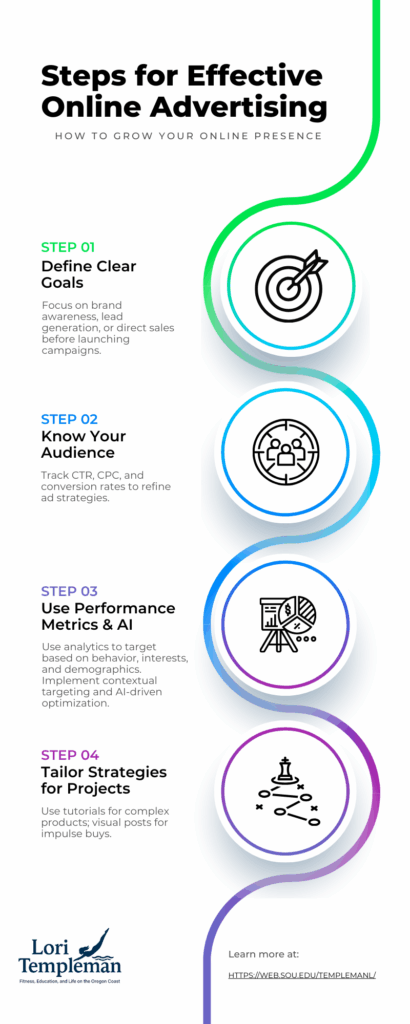
Successful online advertising starts with setting clear goals and identifying target audiences. Ads tailored to user behavior and context tend to generate higher engagement (Stokes & Quirk Education, 2023). Companies should determine whether their focus is brand awareness, lead generation, or direct sales. From there, data analytics can be used to identify and target relevant consumer segments. Platforms like Google Ads and Facebook Ads offer advanced targeting features, enabling advertisers to refine their campaigns using performance metrics such as click-through rates (CTR), cost-per-click (CPC), and return on ad spend (ROAS). For example, a 2024 case study by Hubspot showed that contextual Facebook ads targeting users based on recent search behavior increased conversion rates by 32% compared to generic ads.
Best Practices for Affiliate Marketing
The keys to successful affiliate marketing include authenticity, relevance, and well-matched partnerships. Brands should collaborate with affiliates whose content and audience reflect their values and target demographic. According to Stokes and Quirk Education (2023), affiliate efforts are most impactful when affiliates have earned the trust of their followers. Influencers are categorized by their follower count into mega, macro, micro, and nano tiers. Each tier offers different benefits and opportunities. Cerrato (2025) explains that while micro-influencers (10,000-50,000 followers) are valuable for their authenticity and extensive reach, nano-influencers (1,000 to 10,000 followers) often drive stronger engagement through their focused, niche communities.
AI tools are also reshaping the field of contextual advertising by improving how marketers analyze data, generate content, and fine-tune campaigns. These advancements help marketers make smarter choices and deliver improved experiences to their audience.
A compelling example is Glossier, which successfully leveraged nano-influencers to promote its products. Everyday users shared their skincare routines on Instagram, generating over 20,000 user-generated posts and contributed to a 600% increase in referral traffic over six months (Latterly.org, 2025).
Tailoring Strategies to Products and Services
The choice of advertising and affiliate strategies should reflect the nature of the product or service. For example, products like software or educational courses benefit from detailed reviews and tutorials provided by knowledgeable affiliates. Impulse-buy items such as fashion accessories may perform better through visually appealing social media promotions. Trusted services like financial coaching or wellness programs benefit from credible affiliates. Testimonials and case studies help build consumer confidence.
Conclusion
Online advertising and affiliate marketing are fast-evolving industries that demand continuous adaptation and strategic planning. By utilizing data analytics, building genuine collaborations, and staying ahead of technological trends, companies can enhance their digital outreach. As consumer preferences shift and new platforms emerge, marketers must stay flexible and well-informed to stay competitive.
References
Affiliateguru (2025, August 4). Share A Comprehensive Guide to Affiliate Marketing Success in 2025. M2 Presswire https://hanlib.idm.oclc.org/login?url=https://www.proquest.com/wire-feeds/affiliateguru-share-comprehensive-guide-affiliate/docview/3236074668/se-2
Cerrato, S. (2025, July 14). Micro‑moments and nano‑creativity: An influencer marketing playbook. Forbes. https://www.forbes.com/councils/forbesagencycouncil/2025/07/14/micromoments-and-nanocreativity-an-influencer-marketing-playbook
Gasparyan, D. (2023, September 20). Affiliate marketing: Predictions and strategies for success. Forbes Technology Council. https://www.forbes.com/councils/forbestechcouncil/2023/09/20/affiliate-marketing-predictions-and-strategies-for-success/
HubSpot. (2024). 11 Facebook case studies & success stories to inspire you. HubSpot Blog. https://blog.hubspot.com/marketing/facebook-case-study
Latterly.org. (2025). Glossier marketing strategy 2025: A case study. Latterly. https://www.latterly.org/glossier-marketing-strategy/
Rob Stokes & Quirk Education. (2023). eMarketing: The essential guide to marketing in a digital world (6th ed.). Quirk Education.
Shopify. (n.d.). Shopify affiliate marketing program: Earn income for your referrals. Shopify. https://www.shopify.com/affiliates
Hi Lori,
Thank you for your insightful and well structured post. I appreciate that you included Shopify’s Affiliate Program. I was unfamiliar with this feature and see how simple it can be for someone to become a Shopify affiliate. I think it’s genius marketing on their end as they allow their affiliates to identify themselves and do the work for them. If the affiliates don’t make any sales, the company is no worse off and may even get some free non-sale advertising out of the deal! It is interesting that 83% of marketers use affiliate marketing. I’d be curious to see how that number has increased over time. I think the rise in affiliate marketing can be linked directly to the increase in popularity of platforms such as TikTok and Youtube. It has never been easier and more accessible to become an affiliate for a large variety of brands. I also included the steps for effective advertising on my post as well. Proper planning and clear, well-defined goals are pivotal for making a successful campaign and tracking progress.
Have a wonderful week!
Spencer
Hi Lori! You did a great job laying out the basics of both online advertising and affiliate marketing. The post is clear and easy to follow, starting with an overview before moving into best practices and examples. You explained the connection between advertising and affiliate marketing really well. Many people see them as separate strategies, but your post showed how they overlap and complement each other in campaigns.
One area that could strengthen your post is the addition of a brief discussion on the challenges or mistakes that businesses sometimes encounter with these strategies. For example, affiliate marketing can become less effective when companies work with affiliates who have large followings but little audience relevance, or when tracking systems fail and partners aren’t fairly compensated. Online advertising also encounters problems when campaigns focus on impressions instead of meaningful conversions or when intrusive formats like pop-ups frustrate users. Including a short section on these pitfalls would enhance your best practices by helping readers understand both what to do and what to avoid.